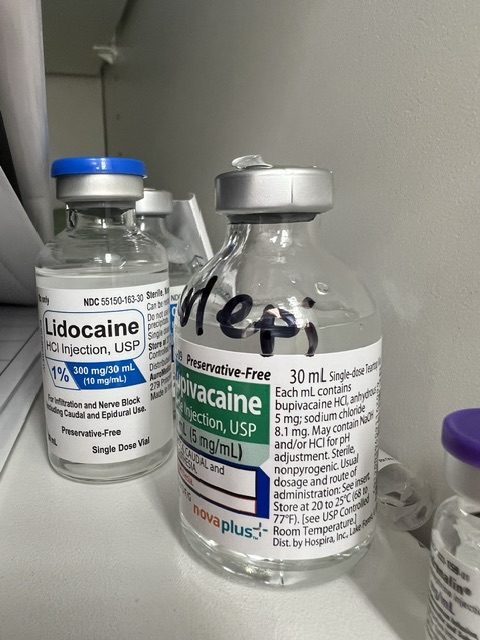

Another week, another medication on the recall list.
High risk times we are living in, am I right?
Story time- A long time ago (2003), in a galaxy far away (California), a surgeon requested, at top volume, “EPI!” to inject a knee. I was newer to the OR then and the volume and the general aggression of the request sent the few of us who were there into a tizzy. The scrub tech and I just blinked at each other, the anesthesiologist didn’t have anything to say. The surgeon stared at us all and barked again “Will someone get me some (bad word) epi for this knee? I need 30 of epi and I need it now!” I hurried to the operating room Pyxis and pulled out 30 of Epinephrine.
And then I stopped and reconsidered the bellow.
This is the medication that is used in advanced cardiac life support to restart someone’s heart.
For the ACLS algorithm for cardiac arrest the dose is 1 mg of epinephrine. Not 30. And the multi dose vial pocket that popped open when I programmed the Pyxis was 30mg, 1 mg/ml.
I shut the little pop open drawer and marched myself back into the room, the surgeon waiting impatiently and looked at them calmly.
They held a hand out and shook it, waiting for me to place a syringe in it.
I refused. I refused because what they was asking for was not really what they wanted. I said “We use 1 mg of epinephrine to restart someone’s heart, not 30. I won’t give 30 mg of epinephrine to you to inject the joint for arthritis pain!”
I thought they were going to blow their top because a nurse was refusing the request.
And then the anesthesiologist woke up to the situation at hand and backed me up.
The surgeon blustered but backed down.
They thought a moment and then said “No, no, what I really want is Marcaine 0.5% with Epinephrine 1:200,000.” This is a local medication, a novacaine cousin that is a local pain medication. The 1:200,000 of Epinephrine is just to make it control bleeding at the injection site and also to make the effects last longer.
I got the Marcaine with epi bottle and prepared the syringe. I showed the bottle when I did so and said, aloud, that it was Marcaine 0.5% with Epinephrine 1:200,000. For good measure, I showed the expiration date of January 22, 2008. And then, and only then, did I hand them the syringe.
The math works like this. 1:200,000 is a dilution of epinephrine. It is important to realize that the standard epinephrine dose is 1 milligram per 1 milliliter or 1 to 1. The dilution calculation is 1 mg of epinephrine in whatever amount of saline it takes to make the desired dilution. In this case it is 199ml of saline and 1 ml of 1:1000 epinephrine. This equals 1 ml of epi in 200 ml of solution. The final concentration, and this is important, is 5 micrograms/ml. 30 ml x 5 micrograms is 150 micrograms of epi total, not 30 milligrams. The common dilutions that have been pre-prepared by the drug manufacturer that we use in the OR are 1:50,000, 1:100,000, and 1:200,000. Thankfully, most of our medication already comes pre-diluted but we have had to make our own dilution in the OR before because of and I always made anesthesia double check how much epi I was adding to the local medication. These events are rare and likely due to a lack of supply from the manufacturer.
To be clear, the surgeon wanted the local medication to sub-cutaneously inject a joint. Not to restart the patient’s heart. Never did I hear a thank you for stopping him from making a catastrophic medication error. Not a peep.
Epinephrine has all sorts of applications but it is usually used for cardiac arrest. There are some other applications such as the local medication or applications in Intensive Care to increase blood pressure.
Yesterday, September 3rd, the FDA issued a recall for a certain manufacturer of three separate lots of a multidose vial (30ml) of Epinephrine 1:1000/ml.
This recall is for particulates such as glass, nylon, polyethylene, acrylic, and cellulosic.
Since epinephrine is used most often in events of anaphylaxis, cardiac arrest, or management of low blood pressure, it is given IV. The presence of a particulate in the blood stream could lead to the particulate acting as a thrombus or a clot and stopping micro blood flow.
This isn’t good and can lead to disability and death
This is why recalls are important!
That is why a robust, non-partisan, in it for the science FDA recall issues are important!
If only the senate had listened when the scientific community shouted that the pick for the DHHS was no good.
Imagine if they had listened.

